Showing posts with label BEF. Show all posts

Sunday, 14 September 2014

September 14

The first Battle of the Masurian Lakes ends in a German victory. The Germans push the Russian First Army back, ejecting it from German soil. Further progress was hampered by the arrival of the Russian Tenth Army on the Germans' left flank. Despite its numerical superiority and heavily fortified defensive position, the Russians suffer defeat and are forced to retreat in disarray. Russian  losses are great, and Russian plans on the Eastern Front are left in disarray.

The Eastern Front, September 1914

In the Battle of the Aisne, a stalemate ensues. Sir John French orders the BEF to begin digging defensive positions - the beginning of trench warfare on the Western Front.

At 4am, 116 of the 26th Brigade RFA is with the 1st Brigade forming an advanced guard. 117 and 118 marches to Tour de Paissy. At 8am 117 and 118 are in action at Arbre de Paissy.At 10.30am 118 advances to a position south of Chemin des Dames.

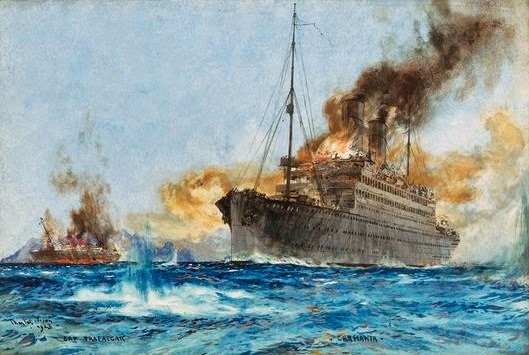
The British armed merchant cruiser RMS Carmania sinks the German auxiliary cruiser SMS Cap Trafalgar off the Trinidade and Martim Vaz archipeligo. The action is otherwise known as the Battle of Trinidade.

The Battle of Trinidade

The Australian submarine AE1 disappears while patrolling the St George's Strait between New Britain and New Ireland. It is the first vessel of the Royal Australian Navy to be lost in the war.


Saturday, 13 September 2014

September 13

The Allied offensive in the Battle of the Aisne commences.

The British advance at the Battle of the Aisne

The 26th Brigade RFA advances to Bourg, "crossed river [Aisne] by canal bridge".

The German cruiser SMS Hela is sunk by the British submarine E9 off Heligoland.

South African troops invade German South West Africa.


Friday, 12 September 2014

September 12

The Battle of the Marne ends. The Germans retreat up to 56 miles losing 11,717 prisoners, 30 guns and 100 machine-guns to the French and 3,500 prisoners to the British, before reaching the Aisne.

French soldiers advancing to take up new positions


In general terms the Marne is an Allied victory which saved Paris and kept France in the war; it also ensured the failure of the Schlieffen Plan for a quick German victory in the West. However there is less agreement as to the extent of the Allies' success.

The 26th Brigade RFA advances to Bazoches.

Recruitment figures show that between 4 August and 12 September, 478,893 men joined the army. This includes 33,204 volunteers on 3 September which was a wartime record.


Friday, 5 September 2014

September 5 - Battle of the Marne begins

The Battle of the Marne begins. It is the culmination of the German advance into Northern France and its pursuit of the Allied armies which followed the Battle of the Frontiers in August.

The Battle of the Marne: Positions on 5 September


HMS Pathfinder
HMS Pathfinder is the first British warship to be sunk by a submarine off the Firth of Forth.

The 26th Brigade, RFA marches to Nesle.


Wednesday, 3 September 2014

September 3

On this day 33,204 men enlist for the British Army. This proves to be the highest daily total of the entire war.

A further list of British casualties is issued: killed, 70; wounded, 390; missing, 4,758.

The 26th Brigade RFA marches to La Ferte sous Jouarre, a crossing point on the River Marne.

HMS Speedy, a minesweeper, sinks after hitting a mine in the Humber estuary.


Monday, 1 September 2014

September 1 - Action at Nery

L Battery in action at Nery
A skirmish takes place at Nery between the British Army and the German Army, part of the Great Retreat. Shortly after dawn, a British cavalry brigade was preparing to leave its overnight bivouac and was attacked by a German cavalry division of about twice their strength. The British artillery was mostly put out of action very quickly, but a single gun of L Battery, Royal Horse Artillery successfully kept up a steady fire for two and a half hours against a full battery of German artillery. British reinforcements arrived at 8am, They counter-attacked, forcing the Germans to retreat. Three men of L Battery were awarded the Victoria Cross for their part in the battle.

The 26th Brigade, RFA is also still retreating. At 1.30pm, "116 & 117 in action half a mile south of Villers-Cotterets with Black Watch covering retirement of 1st Brigade from the town. No engagement." Although not mentioned in the War Diary, the BEF was fighting another rearguard action here. The 4th (Guards) Brigade, covering the withdrawal of the 2nd Division, came into contact with the leading units of the German III Corps on the edge of woodland near the town. The Guards Brigade lost more than 300 men in the encounter, but were able to break away and continue the withdrawal.

Later, the Brigade bivouacks 1 mile south of La Ferte-Milon.

Sunday, 31 August 2014

August 31

The Allies have retired to a line stretching between Amiens and Verdun

British casualties are announced as follows: August 23-26: killed, 163; wounded, 686; missing, 4,278.

The 26th Brigade, RFA marches from Allemant to Vauxbuin.

Tuesday, 26 August 2014

August 26 - Le Cateau

British dead at Le Cateau
The Allied retreat continues. At the Battle of Cateau - a successful rearguard action - the engagement allows the BEF to continue their withdrawal.

Edward Croft, with the RFA, marches from Dompierre to Fesmy.

German Togoland surrenders to the British.

Austria-Hungary declares war on Japan.


SMS Magdeburg
The German cruiser SMS Magdeburg runs aground off the Estonian coast and is captured by the Russians.

They recover three intact German code books, one of which is passed to the British.

This code book is used by the Admiralty's Room 40 to identify movements of German warships.


The German transatlantic liner, Kaiser Wilhelm der Grosse, now acting as an auxiliary cruiser, is sunk by HMS Highflyer.


Punch publishes another Bernard Partridge cartoon. Clearly influenced by recent events in Louvain and Antwerp (depicted in the background), the theme is now much more sinister. Here the Kaiser is depicted as being wholly evil. Punch is using these cartoons for propaganda purposes, to maintain civilian morale.

THE TRIUMPH OF "CULTURE"

Friday, 22 August 2014

August 22 - The BEF's First Shots of the War

The "First Shot" Memorial near Mons
The first British shots of the First World War were fired today. These were the first by a British soldier on the continent of Europe in action against an enemy since Waterloo.

Ahead of the main body of the BEF, cavalry troops were ordered to seek and locate the German Army. On 22 August, the 2nd Cavalry Brigade were patrolling north and east of Mons. In "C" Squadron of the 4th (Royal Irish) Dragoon Guards, the leading patrols set an ambush beside the Maisieres to Casteau road.

At about 7am one of the scouts reported the enemy coming down the road, and No. 1 Troop was ordered to charge. No 4 Troop, following, was ordered to dismount and fire. As Corporal Edward  Thomas later recalled, "I could see a German cavalry officer some 400 yards away ... Immediately I saw him I took aim, pulled the trigger and automatically, almost as it seemed instantaneously, he fell to the ground."


The German Cuirassiers were outnumbered and they fell back, pursued along the Brussels road. Captain Charles Beck Hornby, commanding No 1 Troop, was awarded the Distinguished Service Order, probably the first gallantry award given to a member of the Army in the First World War. (Captain Hornby also had the distinction of probably killing the first German in the war, albeit by sabre rather than by shot.)

Edward Croft, with the 26th Brigade RFA, marched from Boue to Cartignies and again billeted in the 1st Brigade (Guards) area.

In the Battle of the Frontiers, France suffers its greatest loss of life to date, with 27,000 of her soldiers killed.

Austria-Hungary declares war on Belgium.

Thursday, 21 August 2014

August 21 - Battle of Charleroi

The German 2nd and 3rd armies are victorious at the Battle of Charleroi, otherwise known as the Battle of the Sambre.

The Battle of Charleroi


The first British soldier is killed in action, Private John Parr. Parr was attached to the 4th Battalion, Middlesex Regiment, which had disembarked at Boulogne on August 14. The battalion then moved east towards the front in Belgium.

The precise circumstances of Private Parr's death are still unclear. One explanation is that as a "reconnaissance cyclist" (and accompanied by another soldier), he was instructed to locate the enemy. They eventually came across German troops near Obourg. Whilst Parr stayed to monitor their movements, his comrade cycled back to the battalion to report the news. Parr was never seen alive again.

John Parr is buried in the cemetery at St Symphorium. Although his headstone records he was aged 20, he was in fact born in 1898, making him only 16 years old.

The Germans levy £8,000,000 on Brussels (£11 per head of the population) ad £2,400,000 on the province of Liege.

The BEF's concentration in France is practically completed.

Army Order 324 is issued, specifying that six new divisions would be created from units formed from the 100,000 volunteers who had come forward since 6 August. These new divisions are collectively  called "Kitchener's Army" or K1

Saturday, 16 August 2014

August 16 - Gunner Croft Goes to War

For the first time in this digest, one of my relatives appears, as he is called up and goes to war. 19721 Gunner Edward Croft was attached to the 26th Brigade, Royal Field Artillery.

According to the Brigade's War Diary, preserved in the National Archives [WO 95/1250/1], the Brigade mobilised at Aldershot between 5-11 August. I do not know when Edward was actually called up, presumably from the Reserves, but at the latest he would have been in barracks by the 11th.

Cavalry joining a boat train for the Continent. A scene possibly taken at Aldershot

On August 16 the Brigade proceeded to Southampton. The 26th Brigade probably travelled to Aldershot Station (on the London & South Western Railway's system) and thence to the docks. At 5.30pm they embarked on the SS Cardiganshire for France. The Brigade formed part of the British Expeditionary Force.

The troopship SS Cardiganshire, which transported Edward Croft and the 26th Brigade, RFA from Southampton to Boulogne

In the widening war, Serbian forces face Austro-Hungarian forces at the Battle of Cer, which ends in victory for the Serbs.

In Turkey, the Goeben and the Breslau (see August 12) having now reached Constantinople, both vessels were transferred to the Turkish Navy, becoming respectively the Yavuz Sultan Selim and the Midilli, though they retained their German crews.

In Africa, On August 16, 1914, Lake Nyasa was the scene of a brief naval battle when the British gunboat SS Gwendolen, commanded by Captain Rhoades, received orders to, "sink, burn, or destroy" the German Empire's only gunboat on the lake, the Hermann von Wissmann, commanded by Captain Berndt. Rhoades's crew found the Hermann von Wissmann in a bay near Sphinxhaven, in German East African territorial waters. Gwendolen disabled the German boat with a single cannon shot from about 2,000 yards. This brief conflict was hailed by The Times as Britain's first naval victory of the war.

Thursday, 7 August 2014

August 7

The British Expeditionary Force, comprising 120,000 men, lands in France under the command of Sir John French.

As German troops advance, the "Battle of the Frontiers" begins in southern Belgium and eastern France.

The BEF arriving in Boulogne


£1 banknotes are issued and postal-orders made legal tender, as it was feared that people might hoard gold sovereigns (then the general currency). Paper notes could still be changed into gold. One consequence of the war was that the circulation of banknotes increased from £34 million (pre-war) to £299 million (by 1918).


£1 banknote, issued from 7 August 1914