 |
| The Soissons Area |
Showing posts with label Germany. Show all posts
Showing posts with label Germany. Show all posts
Saturday, 20 December 2014
December 20
The Battle of Champagne opens with the French attacking German positions. This is the first major Allied offensive since the onset of trench warfare on the Western Front.

Saturday, 6 December 2014
December 6
The Battle of Lodz ends with both sides claiming victory. The Russians retain control of Warsaw, and the Germans preventing a Russian offensive into Silesia. However, German forces did not break the Russian lines, whilst the Russians
withdraw to form a new and stronger line closer to Warsaw. Casualties on both sides amount to nearly 300,000.

Friday, 31 October 2014
October 31
The seaplane carrier, HMS Hermes, is sunk by the German submarine U27 in the Dover Straits.
In the Battle of the Yser, with the German offensive having stalled, the Allies claim victory by preventing Germany gaining total control of Belgium.
The Battle of the Vistula River, which began on 29 September, ends in a Russian victory.
The Siege of Tsingtao begins with Japanese forces shelling the port and digging trenches.
The 26th Brigade RFA remains in action all day.
 |
| HMS Hermes |
The Battle of the Vistula River, which began on 29 September, ends in a Russian victory.
The Siege of Tsingtao begins with Japanese forces shelling the port and digging trenches.
The 26th Brigade RFA remains in action all day.
Tuesday, 21 October 2014
October 21 - Unconquerable Belgium
Punch publishes another fine cartoon by Bernard Partridge expressing perfectly Belgium's indomitable spirit.
It is announced that expenditure on the war, which in the first ten weeks averaged about five and a half million pounds a week, has risen to about eight and a quarter million pounds a week.
 |
| UNCONQUERABLE |
The Kaiser: "So you see - you've lost everything"
The King of the Belgians: "Not my soul"
It is announced that expenditure on the war, which in the first ten weeks averaged about five and a half million pounds a week, has risen to about eight and a quarter million pounds a week.
Wednesday, 15 October 2014
October 15
German troops occupy Zeebrugge and Ostend.
The Admiralty announces the sinking of the Hamburg-Amerika liner Markomannia and the capture of the Greek steamer Pontoporos (the SMS Emden's colliers), near Sumatra, by HMS Yarmouth.
HMS Hawke is sunk by the German submarine U9 in the North Sea. 524 officers and men are killed, including the ship's captain, Hugh P. E. T. Williams.
The Admiralty announces the sinking of the Hamburg-Amerika liner Markomannia and the capture of the Greek steamer Pontoporos (the SMS Emden's colliers), near Sumatra, by HMS Yarmouth.
.jpg) |
| HMS Yarmouth |
HMS Hawke is sunk by the German submarine U9 in the North Sea. 524 officers and men are killed, including the ship's captain, Hugh P. E. T. Williams.
Tuesday, 14 October 2014
October 14
The Germans occupy Bruges, and British red Cross nurses are expelled from Antwerp.
Punch publishes the cartoon "A North Sea Chantey" reminding readers of the power of the Royal Navy.

Punch publishes the cartoon "A North Sea Chantey" reminding readers of the power of the Royal Navy.
Sunday, 12 October 2014
October 12
The Battle of Messines commences with German and British forces engaged between the Comines-Ypres Canal and the River Douve.
The Germans are reported to have 1,500,000 troops in the west and 1,800,000 in the east.
Martial law is declared in South Africa in the wake of the Maritz Rebellion.
 |
| The Messines area |
The Germans are reported to have 1,500,000 troops in the west and 1,800,000 in the east.
Martial law is declared in South Africa in the wake of the Maritz Rebellion.
Saturday, 11 October 2014
October 11

Friday, 10 October 2014
October 10
The Germans expel British Red Cross nurses from Brussels.
The death of King Carol I of Romania is announced. He is succeeded by King Ferdinand I.
The death of King Carol I of Romania is announced. He is succeeded by King Ferdinand I.
Saturday, 4 October 2014
October 4
 |
| The Battle of Arras |
Thursday, 2 October 2014
October 2
The Germans capture the Belgian city of Dendermonde. Over half its houses are damaged or destroyed.
The Admiralty announces it will be taking measures to counter the German policy of mine-laying in the North Sea.
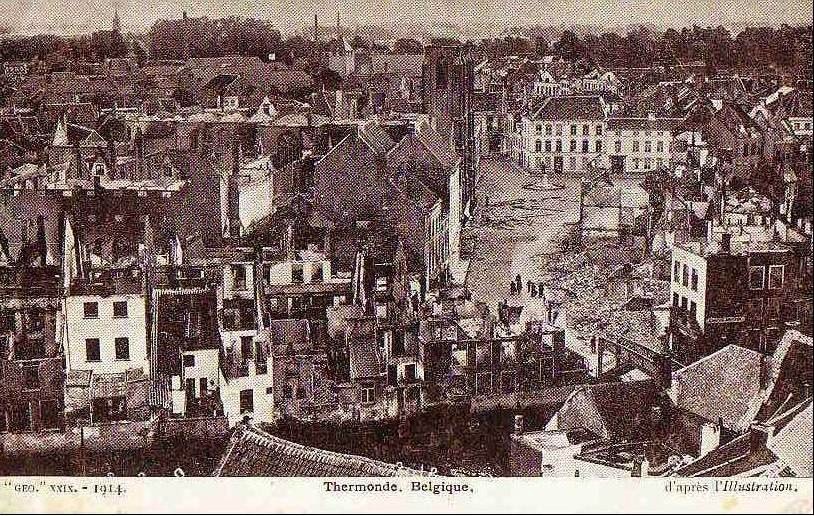 |
| Destruction in Dendermonde |
The Admiralty announces it will be taking measures to counter the German policy of mine-laying in the North Sea.
Wednesday, 1 October 2014
October 1
The Battle of Arras sees the French trying to outflank German forces and prevent their advance to the coast.
The Germans continue to pound the forts surrounding Antwerp.
The Admiralty reports that HMS Cumberland captured ten German merchant vessels off the Cameroon River in West Africa.
The Germans continue to pound the forts surrounding Antwerp.
 |
| HMS Cumberland |
The Admiralty reports that HMS Cumberland captured ten German merchant vessels off the Cameroon River in West Africa.
Tuesday, 30 September 2014
September 30
The Antwerp waterworks are destroyed by the Germans.
The 26th Brigade RFA remains in position, with no firing taking place.
Punch publishes a cartoon of the Kaiser entitled "The Great Goth". It shows a suggested "design for a strained-glass window in a neo-gothic cathedral at Potsdam". The Kaiser is shown as a grotesque angel holding the smoking ruins of Rheims Cathedral (see 20 September) on the left, whilst further battle "honours" are listed at his feet: Malines, Louvain (see 25 August) and Termonde.

The 26th Brigade RFA remains in position, with no firing taking place.
Punch publishes a cartoon of the Kaiser entitled "The Great Goth". It shows a suggested "design for a strained-glass window in a neo-gothic cathedral at Potsdam". The Kaiser is shown as a grotesque angel holding the smoking ruins of Rheims Cathedral (see 20 September) on the left, whilst further battle "honours" are listed at his feet: Malines, Louvain (see 25 August) and Termonde.
Monday, 29 September 2014
September 29 - The "Angels of Mons"
 |
| Arthur Machen |
German and French forces reach a stalemate in the Battle of Albert. Hostilities continue as trench warfare, whilst the remaining gap in the front line starts the so-called "Race to the Sea".
The 26th Brigade RFA remains in position, with no firing taking place.
On the Eastern Front, the Russians clash with German and Austro-Hungarian forces in the Battle of the Vistula River (also known as the Battle of Warsaw). The battle continues until the end of October.
Sunday, 28 September 2014
September 28
The bombardment and siege of Antwerp begins. German guns are directed by observers in fixed balloons.
The Admiralty publishes a statement of losses in shipping since the outbreak of war: German 1,140,000 tons (387 ships); British 229,000 tons (86 ships).
The 26th Brigade RFA remains in position, with no firing taking place.
 |
| The defences of Antwerp |
The Admiralty publishes a statement of losses in shipping since the outbreak of war: German 1,140,000 tons (387 ships); British 229,000 tons (86 ships).
The 26th Brigade RFA remains in position, with no firing taking place.
Tuesday, 23 September 2014
September 23
Men of the South Wales Borderers are landed at Laoshan Bay, China, to assist the Japanese siege of Tsingtao, held by the Germans.
The 26th Brigade RFA remains in position. At 4.30am 118 moves 300 years west of its previous location, and at 6.30am both batteries open fire on Labouelle and Source in suport of a French attack on La Creute and Hurtebise Fme.
 |
| British troops arriving at Laoshan Bay |
The 26th Brigade RFA remains in position. At 4.30am 118 moves 300 years west of its previous location, and at 6.30am both batteries open fire on Labouelle and Source in suport of a French attack on La Creute and Hurtebise Fme.
Monday, 22 September 2014
September 22 - Disaster for the Royal Navy
A naval engagement takes place in which three obsolete Royal Navy cruisers, manned mainly by reservists and sometimes referred to as the "live bait squadron", are sunk by the German submarine U9. Approximately 1,450 sailors are killed, and there is a public
outcry at the losses. The incident erodes confidence in the British
government and damages the reputation of the Royal Navy. The British ships lost are HMS Cressy, HMS Aboukir, and HMS Hogue. The Captain of the U9, Otto Weddigen, returns to a hero's welcome.
In France the 26th Brigade RFA remains in positions. 118 is "shelled by heavy howitzers all day, 1 gun disabled." Both batteries are engaged with enemy guns about Cerny and Labouelle.
Britain launches its first air raid against Germany. Flying from Antwerp, two aircraft from No. 1 Squadron, RNAS, flown by Major Eugene Gerrard and Flight Lieutenant Collet fly two hundred miles to Düsseldorf to bomb the Zeppelin shed there; whilst two aircraft from No. 2 Squadron are detailed to attack Cologne. Due to poor weather, the attack on Cologne is aborted, and Major Gerrard also turns back. Collett presses home his attack by descending to only 400 feet and drops three bombs. Despite failing to damage any airship, news of the raid provides a useful boost to Allied morale.
During the evening, SMS Emden approaches the city of Madras on the southeastern coast of the Indian peninsula. Entering Madras harbour, the Emden opens fire at 9.30pm on several large oil tanks belonging to the Burmah Oil Company.
 |
| German propaganda postcard commemorating U9's sinking of three British cruisers |
In France the 26th Brigade RFA remains in positions. 118 is "shelled by heavy howitzers all day, 1 gun disabled." Both batteries are engaged with enemy guns about Cerny and Labouelle.
Britain launches its first air raid against Germany. Flying from Antwerp, two aircraft from No. 1 Squadron, RNAS, flown by Major Eugene Gerrard and Flight Lieutenant Collet fly two hundred miles to Düsseldorf to bomb the Zeppelin shed there; whilst two aircraft from No. 2 Squadron are detailed to attack Cologne. Due to poor weather, the attack on Cologne is aborted, and Major Gerrard also turns back. Collett presses home his attack by descending to only 400 feet and drops three bombs. Despite failing to damage any airship, news of the raid provides a useful boost to Allied morale.
During the evening, SMS Emden approaches the city of Madras on the southeastern coast of the Indian peninsula. Entering Madras harbour, the Emden opens fire at 9.30pm on several large oil tanks belonging to the Burmah Oil Company.
 |
| The bombardment of Madras |
Wednesday, 17 September 2014
September 17

Austro-Hungarian forces retreating from the advancing Russians are assisted by the newly-formed German 9th Army.
The 26th Brigade RAF remain in position. The war diary records, "Enemy made an attack in morning ... 118 withdrawn to north east of Tour de Paissy. About 3pm Enemy attacked from direction of Cerny. Both batteries searching north of Cerny."
Sunday, 14 September 2014
September 14
The first Battle of the Masurian Lakes ends in a German victory. The Germans push the Russian First Army
back, ejecting it from German soil. Further progress was hampered by the arrival of the Russian Tenth Army on the Germans' left flank. Despite its numerical superiority and heavily fortified defensive position, the Russians
suffer defeat and are forced to retreat in disarray. Russian losses are great, and Russian plans on the Eastern Front are left in disarray.
In the Battle of the Aisne, a stalemate ensues. Sir John French orders the BEF to begin digging defensive positions - the beginning of trench warfare on the Western Front.
At 4am, 116 of the 26th Brigade RFA is with the 1st Brigade forming an advanced guard. 117 and 118 marches to Tour de Paissy. At 8am 117 and 118 are in action at Arbre de Paissy.At 10.30am 118 advances to a position south of Chemin des Dames.
The British armed merchant cruiser RMS Carmania sinks the German auxiliary cruiser SMS Cap Trafalgar off the Trinidade and Martim Vaz archipeligo. The action is otherwise known as the Battle of Trinidade.
The Australian submarine AE1 disappears while patrolling the St George's Strait between New Britain and New Ireland. It is the first vessel of the Royal Australian Navy to be lost in the war.
 |
| The Eastern Front, September 1914 |
In the Battle of the Aisne, a stalemate ensues. Sir John French orders the BEF to begin digging defensive positions - the beginning of trench warfare on the Western Front.
At 4am, 116 of the 26th Brigade RFA is with the 1st Brigade forming an advanced guard. 117 and 118 marches to Tour de Paissy. At 8am 117 and 118 are in action at Arbre de Paissy.At 10.30am 118 advances to a position south of Chemin des Dames.
The British armed merchant cruiser RMS Carmania sinks the German auxiliary cruiser SMS Cap Trafalgar off the Trinidade and Martim Vaz archipeligo. The action is otherwise known as the Battle of Trinidade.
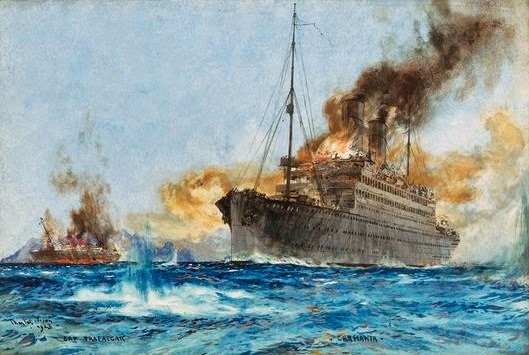 |
| The Battle of Trinidade |
The Australian submarine AE1 disappears while patrolling the St George's Strait between New Britain and New Ireland. It is the first vessel of the Royal Australian Navy to be lost in the war.
Saturday, 13 September 2014
September 13
The Allied offensive in the Battle of the Aisne commences.
The 26th Brigade RFA advances to Bourg, "crossed river [Aisne] by canal bridge".
The German cruiser SMS Hela is sunk by the British submarine E9 off Heligoland.
South African troops invade German South West Africa.
 |
| The British advance at the Battle of the Aisne |
The 26th Brigade RFA advances to Bourg, "crossed river [Aisne] by canal bridge".
The German cruiser SMS Hela is sunk by the British submarine E9 off Heligoland.
South African troops invade German South West Africa.
Subscribe to:
Comments (Atom)