 |
| The Cloth Hall at Ypres under being shelled by German guns |
Showing posts with label Belgium. Show all posts
Showing posts with label Belgium. Show all posts
Saturday, 22 November 2014
November 22
The Battle of Ypres ends with the Germans failing to capture the town. Both sides dig trenches protected by barbed wire and machine guns, and the "Western Front" of almost static trench warfare is completed.

Friday, 31 October 2014
October 31
The seaplane carrier, HMS Hermes, is sunk by the German submarine U27 in the Dover Straits.
In the Battle of the Yser, with the German offensive having stalled, the Allies claim victory by preventing Germany gaining total control of Belgium.
The Battle of the Vistula River, which began on 29 September, ends in a Russian victory.
The Siege of Tsingtao begins with Japanese forces shelling the port and digging trenches.
The 26th Brigade RFA remains in action all day.
 |
| HMS Hermes |
The Battle of the Vistula River, which began on 29 September, ends in a Russian victory.
The Siege of Tsingtao begins with Japanese forces shelling the port and digging trenches.
The 26th Brigade RFA remains in action all day.
Sunday, 26 October 2014
October 26
 |
| Battle of the Yser |
The 26th Brigade RFA is now based at Zillebeke. During the day, the 57th howitzer battery is in action at Veldoek firing against Poezehoer; 117 is in action east of Gheluvelt firing against trenches north of Reidelbeek; 116 is in action at Veldhuer firing against trenches south of Zuidhuer.
Saturday, 25 October 2014
October 25
 |
| Sir Charles Douglas (1850-1914) |
The 26th Brigade RFA marches to Zillebeke.
The death is announced of Sir Charles Douglas, Chief of the Imperial General Staff.
Tuesday, 21 October 2014
October 21 - Unconquerable Belgium
Punch publishes another fine cartoon by Bernard Partridge expressing perfectly Belgium's indomitable spirit.
It is announced that expenditure on the war, which in the first ten weeks averaged about five and a half million pounds a week, has risen to about eight and a quarter million pounds a week.
 |
| UNCONQUERABLE |
The Kaiser: "So you see - you've lost everything"
The King of the Belgians: "Not my soul"
It is announced that expenditure on the war, which in the first ten weeks averaged about five and a half million pounds a week, has risen to about eight and a quarter million pounds a week.
Thursday, 16 October 2014
October 16
The Battle of the Yser begins.
Sir John French's Second Despatch is published in the London Gazette. It describes the retreat from Le Cateau to the far side of the Seine and the dramatic turnabout and epic Battle of the Marne. Sir John's Third Despatch, covering the Battle of the Aisne, when the Germans dug in and defended stoutly. Movement was over and trench warfare began, is also published in the same edition.
Troops of the New Zealand Expeditionary Force set sail from Wellington.
 |
| Battle of the Yser |
Sir John French's Second Despatch is published in the London Gazette. It describes the retreat from Le Cateau to the far side of the Seine and the dramatic turnabout and epic Battle of the Marne. Sir John's Third Despatch, covering the Battle of the Aisne, when the Germans dug in and defended stoutly. Movement was over and trench warfare began, is also published in the same edition.
Troops of the New Zealand Expeditionary Force set sail from Wellington.
Wednesday, 15 October 2014
October 15
German troops occupy Zeebrugge and Ostend.
The Admiralty announces the sinking of the Hamburg-Amerika liner Markomannia and the capture of the Greek steamer Pontoporos (the SMS Emden's colliers), near Sumatra, by HMS Yarmouth.
HMS Hawke is sunk by the German submarine U9 in the North Sea. 524 officers and men are killed, including the ship's captain, Hugh P. E. T. Williams.
The Admiralty announces the sinking of the Hamburg-Amerika liner Markomannia and the capture of the Greek steamer Pontoporos (the SMS Emden's colliers), near Sumatra, by HMS Yarmouth.
.jpg) |
| HMS Yarmouth |
HMS Hawke is sunk by the German submarine U9 in the North Sea. 524 officers and men are killed, including the ship's captain, Hugh P. E. T. Williams.
Tuesday, 14 October 2014
October 14
The Germans occupy Bruges, and British red Cross nurses are expelled from Antwerp.
Punch publishes the cartoon "A North Sea Chantey" reminding readers of the power of the Royal Navy.

Punch publishes the cartoon "A North Sea Chantey" reminding readers of the power of the Royal Navy.
Monday, 13 October 2014
October 13
The Battle of Armentieres begins as Allied forces plan to block the advancing Germans in a further stage of the "Race to the Sea". The battle continues until 2 November.
The Belgian Government moves to Havre.
The Germans occupy Lille, destroying over 2,200 buildings and burning an entire area of the town.
The first Canadian troops arrive in Europe, landing at Plymouth.
 |
| The Battle of Armentieres |
The Belgian Government moves to Havre.
The Germans occupy Lille, destroying over 2,200 buildings and burning an entire area of the town.
The first Canadian troops arrive in Europe, landing at Plymouth.
Saturday, 11 October 2014
October 11

Thursday, 9 October 2014
October 9 - Fall of Antwerp
Antwerp, under siege from German forces since 28 September, surrenders. The Germans occupy the city and some British and Belgian troops escape to Holland and are interned
for the duration of the war. The remaining troops from Antwerp withdraw to
the Yser river, close to the French border. Here they dig in, to begin the
defence of the last unoccupied part of Belgium.
 |
| The fall of Antwerp and the retreat to the Yser |
Wednesday, 8 October 2014
Tuesday, 7 October 2014
October 7
The Belgian Government moves to Ostend, and the evacuation of Antwerp begins.
The British submarine E9 returns safely after sinking a German destroyer off the River Ems.
Japanese forces occupy Yap Island in the Pacific, used by the Germans as a naval communication centre.
The British submarine E9 returns safely after sinking a German destroyer off the River Ems.
 |
| HMS E9 |
Japanese forces occupy Yap Island in the Pacific, used by the Germans as a naval communication centre.
Friday, 3 October 2014
October 3
The Royal Navy starts to lay mines between the Goodwin Sands and Ostend.
Troops from the Royal Naval Division arrive in Antwerp to assist the Belgians.

Troops from the Royal Naval Division arrive in Antwerp to assist the Belgians.
Thursday, 2 October 2014
October 2
The Germans capture the Belgian city of Dendermonde. Over half its houses are damaged or destroyed.
The Admiralty announces it will be taking measures to counter the German policy of mine-laying in the North Sea.
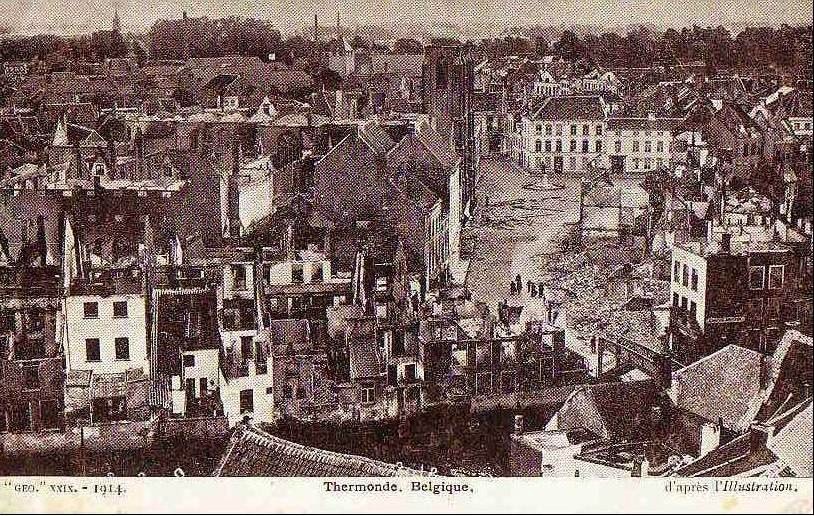 |
| Destruction in Dendermonde |
The Admiralty announces it will be taking measures to counter the German policy of mine-laying in the North Sea.
Wednesday, 1 October 2014
October 1
The Battle of Arras sees the French trying to outflank German forces and prevent their advance to the coast.
The Germans continue to pound the forts surrounding Antwerp.
The Admiralty reports that HMS Cumberland captured ten German merchant vessels off the Cameroon River in West Africa.
The Germans continue to pound the forts surrounding Antwerp.
 |
| HMS Cumberland |
The Admiralty reports that HMS Cumberland captured ten German merchant vessels off the Cameroon River in West Africa.
Sunday, 28 September 2014
September 28
The bombardment and siege of Antwerp begins. German guns are directed by observers in fixed balloons.
The Admiralty publishes a statement of losses in shipping since the outbreak of war: German 1,140,000 tons (387 ships); British 229,000 tons (86 ships).
The 26th Brigade RFA remains in position, with no firing taking place.
 |
| The defences of Antwerp |
The Admiralty publishes a statement of losses in shipping since the outbreak of war: German 1,140,000 tons (387 ships); British 229,000 tons (86 ships).
The 26th Brigade RFA remains in position, with no firing taking place.
Monday, 25 August 2014
August 25 - Louvain destroyed
Louvain is destroyed by German forces.
A contemporary caption to this photograph states, "All that remains of the world-famous library at Louvain, the intellectual metropolis of the Low Countries. The wreckage represents the triumph of German "culture" over the scholarly culture [of] Louvain ..."
Antwerp is bombed by a Zeppelin. This artist's impression (left) was accompanied by this caption, "The Zeppelin bombardment of Antwerp, in defiance of the Hague Convention. The airship dropped shrapnel bombs ... These raids aroused much indignation both in Europe and America ..."
In Galicia, Austria-Hungarian 1st Army defeats the Russian 4th Army.
The Allies continue to retreat, fighting rearguard actions. The 26th Brigade, RFA, retires from La Longueville to Dompierre.
The Royal Flying Corps claims its first victory, Increasing numbers of reconnaissance flights take place during the "Great Retreat". On this day, three aircraft of No.2 Squadron chase an enemy monoplane and force it to land. It was destroyed by the RFC on the ground. Another German aircraft was also captured later.
 |
| Destruction in Louvain |
 |
| The bombing of Antwerp |
In Galicia, Austria-Hungarian 1st Army defeats the Russian 4th Army.
The Allies continue to retreat, fighting rearguard actions. The 26th Brigade, RFA, retires from La Longueville to Dompierre.
The Royal Flying Corps claims its first victory, Increasing numbers of reconnaissance flights take place during the "Great Retreat". On this day, three aircraft of No.2 Squadron chase an enemy monoplane and force it to land. It was destroyed by the RFC on the ground. Another German aircraft was also captured later.
Friday, 22 August 2014
August 22 - The BEF's First Shots of the War
 |
| The "First Shot" Memorial near Mons |
Ahead of the main body of the BEF, cavalry troops were ordered to seek and locate the German Army. On 22 August, the 2nd Cavalry Brigade were patrolling north and east of Mons. In "C" Squadron of the 4th (Royal Irish) Dragoon Guards, the leading patrols set an ambush beside the Maisieres to Casteau road.
At about 7am one of the scouts reported the enemy coming down the road, and No. 1 Troop was ordered to charge. No 4 Troop, following, was ordered to dismount and fire. As Corporal Edward Thomas later recalled, "I could see a German cavalry officer some 400 yards away ... Immediately I saw him I took aim, pulled the trigger and automatically, almost as it seemed instantaneously, he fell to the ground."
The German Cuirassiers were outnumbered and they fell back, pursued along the Brussels road. Captain Charles Beck Hornby, commanding No 1 Troop, was awarded the Distinguished Service Order, probably the first gallantry award given to a member of the Army in the First World War. (Captain Hornby also had the distinction of probably killing the first German in the war, albeit by sabre rather than by shot.)
Edward Croft, with the 26th Brigade RFA, marched from Boue to Cartignies and again billeted in the 1st Brigade (Guards) area.
In the Battle of the Frontiers, France suffers its greatest loss of life to date, with 27,000 of her soldiers killed.
Austria-Hungary declares war on Belgium.
Thursday, 21 August 2014
August 21 - Battle of Charleroi
The German 2nd and 3rd armies are victorious at the Battle of Charleroi, otherwise known as the Battle of the Sambre.
 The first British soldier is killed in action, Private John Parr. Parr was attached to the 4th Battalion, Middlesex Regiment, which had disembarked at Boulogne on August 14. The battalion then moved east towards the front in Belgium.
The precise circumstances of Private Parr's death are still unclear. One explanation is that as a "reconnaissance cyclist" (and accompanied by another soldier), he was instructed to locate the enemy. They eventually came across German troops near Obourg. Whilst Parr stayed to monitor their movements, his comrade cycled back to the battalion to report the news. Parr was never seen alive again.
John Parr is buried in the cemetery at St Symphorium. Although his headstone records he was aged 20, he was in fact born in 1898, making him only 16 years old.
The Germans levy £8,000,000 on Brussels (£11 per head of the population) ad £2,400,000 on the province of Liege.
The BEF's concentration in France is practically completed.
Army Order 324 is issued, specifying that six new divisions would be created from units formed from the 100,000 volunteers who had come forward since 6 August. These new divisions are collectively called "Kitchener's Army" or K1
 |
| The Battle of Charleroi |
The precise circumstances of Private Parr's death are still unclear. One explanation is that as a "reconnaissance cyclist" (and accompanied by another soldier), he was instructed to locate the enemy. They eventually came across German troops near Obourg. Whilst Parr stayed to monitor their movements, his comrade cycled back to the battalion to report the news. Parr was never seen alive again.
John Parr is buried in the cemetery at St Symphorium. Although his headstone records he was aged 20, he was in fact born in 1898, making him only 16 years old.
The Germans levy £8,000,000 on Brussels (£11 per head of the population) ad £2,400,000 on the province of Liege.
The BEF's concentration in France is practically completed.
Army Order 324 is issued, specifying that six new divisions would be created from units formed from the 100,000 volunteers who had come forward since 6 August. These new divisions are collectively called "Kitchener's Army" or K1
Subscribe to:
Posts (Atom)